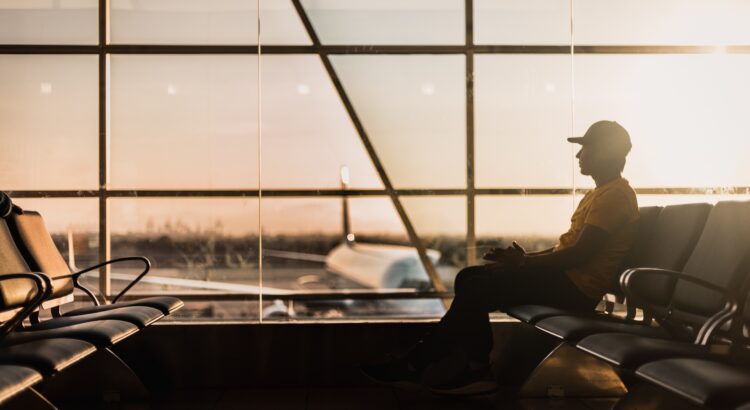
a person waits in an airport lounge

UK Flight Delays: How the right Travel Insurance can help

Picture this: You’re all set for your dream vacation, ready to explore historic landmarks, lounge in the sun, and immerse yourself in a new culture. But then, you find yourself stuck at the airport due to a flight delay. It’s a frustrating situation that can disrupt your travel plans and lead to unexpected expenses. Fortunately, this is where travel insurance comes to the rescue.

Recent news of flight delays in the UK has left many jet-setters concerned about their upcoming journeys. While you can’t control the weather or airline operations, you can protect your travel plans with the right insurance. In this blog, we’ll explore the importance of travel insurance, especially in light of the recent flight delays in the UK, and how it can be your best companion when traveling abroad.

Understanding the Recent Flight Delays

Before diving into the importance of travel insurance, let’s take a closer look at the recent flight delays in the UK. These delays are often caused by a variety of factors, including:

  • Weather Conditions: The UK’s unpredictable weather can disrupt flight schedules. Fog, snow, heavy rain, and strong winds are just a few examples of weather-related challenges that can lead to delays.
  • Air Traffic Control Issues: Technical glitches or strikes within the air traffic control system can cause significant disruptions to flight schedules.
  • Operational Challenges: Airlines sometimes face operational difficulties such as crew shortages, maintenance issues, or aircraft availability problems, which can result in delays.
  • Security Concerns: Security threats or incidents can lead to flight cancellations or delays.

These factors, though beyond your control, can seriously impact your travel plans. So, what can you do to safeguard your journey? The answer lies in purchasing travel insurance.

The Importance of Travel Insurance

One of the primary benefits of travel insurance is its ability to provide financial protection. If your flight is delayed, cancelled, or rescheduled, you may incur additional expenses such as hotel accommodations, meals, and transportation. Travel insurance can cover these costs, ensuring you don’t bear the financial burden. Other benefits include:

  • Trip Cancellation Coverage: In the unfortunate event that you need to cancel your trip due to unforeseen circumstances such as illness, injury, or a family emergency, travel insurance can help reimburse you for the non-refundable expenses you’ve already paid.
  • Emergency Medical Coverage: When traveling abroad, it’s crucial to have coverage for unexpected medical expenses. Travel insurance often includes coverage for medical emergencies, ensuring you receive the necessary care without exorbitant bills.
  • Lost or Delayed Luggage: If your luggage is lost, stolen, or delayed, travel insurance can provide compensation for the essential items you need while waiting for your belongings to be located or replaced.
  • Travel Assistance: Some travel insurance policies come with 24/7 travel assistance services. This can be invaluable if you encounter problems while abroad, such as language barriers or locating medical facilities.

Choosing the Right Travel Insurance

Now that you understand the importance of travel insurance, here are some tips for selecting the right policy:

  • Coverage Needs: Assess your specific travel needs. Are you traveling with valuable items? Do you have pre-existing medical conditions? Tailor your insurance coverage accordingly.
  • Compare Policies: There’s not a one-size-fits-all Travel Insurance cover. It’s worth looking around for a policy that offers the coverage you need at a competitive price.
  • Read the Fine Print: Carefully review the policy terms and conditions to understand what is covered and any limitations or exclusions.
  • Purchase Early: Buy travel insurance as soon as you book your trip. This ensures you’re covered for trip cancellation or interruption from the get-go.

At Rowett Insurance, we can help you get this right, just give us a call on 01726 871144 option 1.

In a world where travel disruptions can happen unexpectedly, travel insurance provides peace of mind and financial protection. The recent flight delays in the UK serve as a reminder that even the most meticulously planned journeys can encounter hiccups. By investing in travel insurance, you’re not just safeguarding your travel plans; you’re also ensuring that your adventure abroad remains a memorable and enjoyable experience, regardless of any unforeseen challenges. So, before you jet off to your next destination, make sure you have the right travel insurance policy in place—it’s your best companion for a worry-free journey.

two people discussing business with a laptop

Underinsurance explained, with Aviva

What is underinsurance?

Underinsurance occurs when you don’t have enough insurance cover to meet your needs. So, if the declared values of property and assets aren’t correct, or when the time it would take to get your business back up and running after a loss is underestimated, you could be underinsured.

Unfortunately, the unexpected can happen and you may need to make a claim. If you do, the last thing you want to hear is that the level of insurance cover you have won’t cover your costs. But that’s what could happen if you’re underinsured.

How could I be underinsured?

Incorrect Sums Insured limit

It’s not nice to think of, but if you were to suffer a large loss tomorrow, how much would it cost to completely rebuild and reinstate your business?

This is what your Sums Insured limit covers. And it’s not just the bricks and mortar. This covers the cost of replacing key components including plant machinery, and equipment.

Inadequate Business Interruption (BI)

If you’ve thought about the cost of rebuilding and reinstating your business, how long do you think it would take to get all of that building work agreed and completed, and your equipment ordered and installed? Not to mention the time it will take to build back your customer base to previous levels. This is where your business interruption period comes into play. If your BI limit isn’t adequate, you may not be able to cover the full estimated loss of earnings during a period of reinstatement, leaving you financially vulnerable.

Not reviewing these limits regularly

If you haven’t had an independent professional valuation done in the last 12 months, we’d highly recommend you do so. It can be difficult to understand exactly how much cover you need at the best of times, but right now, it’s trickier than ever – inflation, increased cost of building materials, supply chain disruption and a shortage of skilled workers are all causing the cost of getting back to business to go up.

What about indexation?

If the initial Sum Insured are too low, the indexation applied to your policy in line with inflation may have little to no impact. What’s more, inflation indexation alone won’t account for costly delays or increases in other costing factors.

Aviva Business Insurance
From Aviva

Did you know…

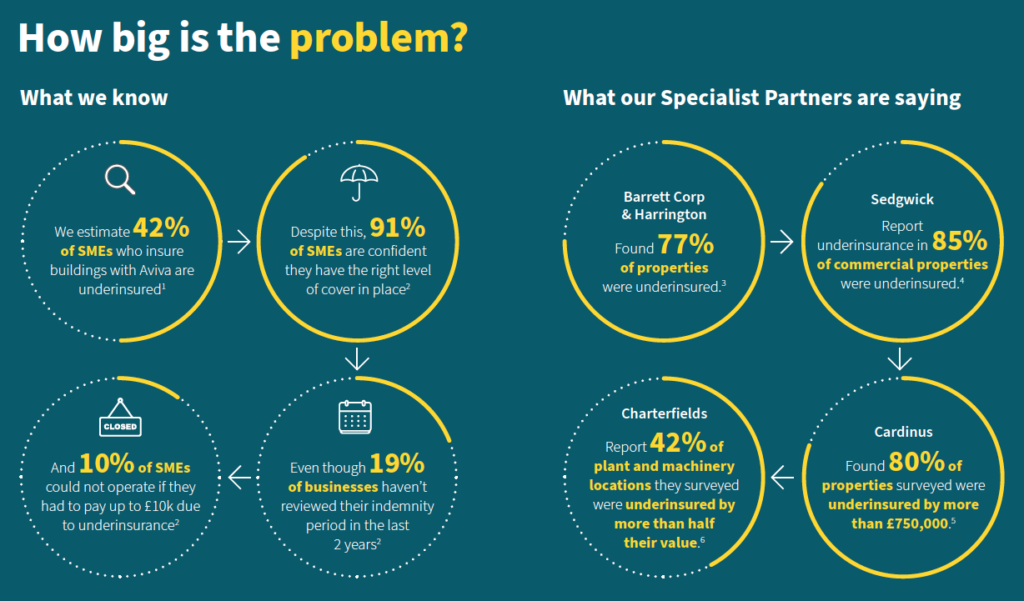
10% of SMEs – that’s more than half a million UK businesses – believe they wouldn’t survive if they had to pay up to £10,000 towards a claim that wasn’t fully covered by insurance.

Why won’t an insurer always cover the full loss?

Any claim will only be paid based on the amount of cover chosen. This is called the ‘average clause’. Any claim you need to make – however big or small – will be impacted by the percentage difference between your recommended total sum and the actual sum for which you’re insured.

You should carefully consider the percentage difference between the recommended cover limits and the amount you choose to cover, rather than simply focusing on the total amounts.

What are the consequences?

  • Production delays
  • Employee wellbeing issues
  • Cash flow problems
  • Loss of revenue
  • Supply chain problems
  • Impact on share price
  • Loss of key employees
  • Disappointed customers
  • Reputational damage

How long will it take to get back to normal?

We call this the ‘period of indemnity’. Making sure you have calculated this correctly protects your income and cash flow if anything impacts normal operations. It can often take longer than you think to bounce back.

For instance, if a business needed to rebuild a warehouse after a fire, attaining planning permission could delay work for months. If just one piece of specialist equipment breaks down, it could mean they can’t run properly until a replacement can be sourced.

A recent analysis of large claims (over £100,000) settled by Aviva between 2018 and 2021 found that the average lifecycle to close a claim was 385 days.

However, on average, SMEs said it would take just under six months for their business to be able to return to normal operations following a major loss, such as a fire or flood. If you’re not sure what your period of indemnity should be, speak to your broker.

How do you know if you’re underinsured?

  1. Get a professional valuation
    Working out how much accidents, and other business interruptions, could set you back can be complex. But having to pay more than you bargained for – or waiting longer than you thought to get back up and running – could leave your business struggling. An expert valuation can help you get a true idea of the total value of your assets, so you can choose an appropriate level of cover.
  2. Have regular catch-ups with your broker
    It can also be difficult to stay on top of the market conditions that could affect your insurance policy – such as labour shortages, rising material costs, or wider supply chain issues. Regular catch ups with your broker can help you understand how much cover you need. It’s also important to tell them about changes you’ve made. Things like new plant and machinery, property alterations and inflated stock levels can impact the level of cover required.

Get in touch with us to discuss your policy and check you have the right level of cover in place: 01726 871144 / 69400.

Further reading and case studies

Click to read

Historical new premises for our Plymouth office

Customers visiting us at our offices in Plymouth will get a slice of history when they next visit after our move to the splendid Crownhill Fort.

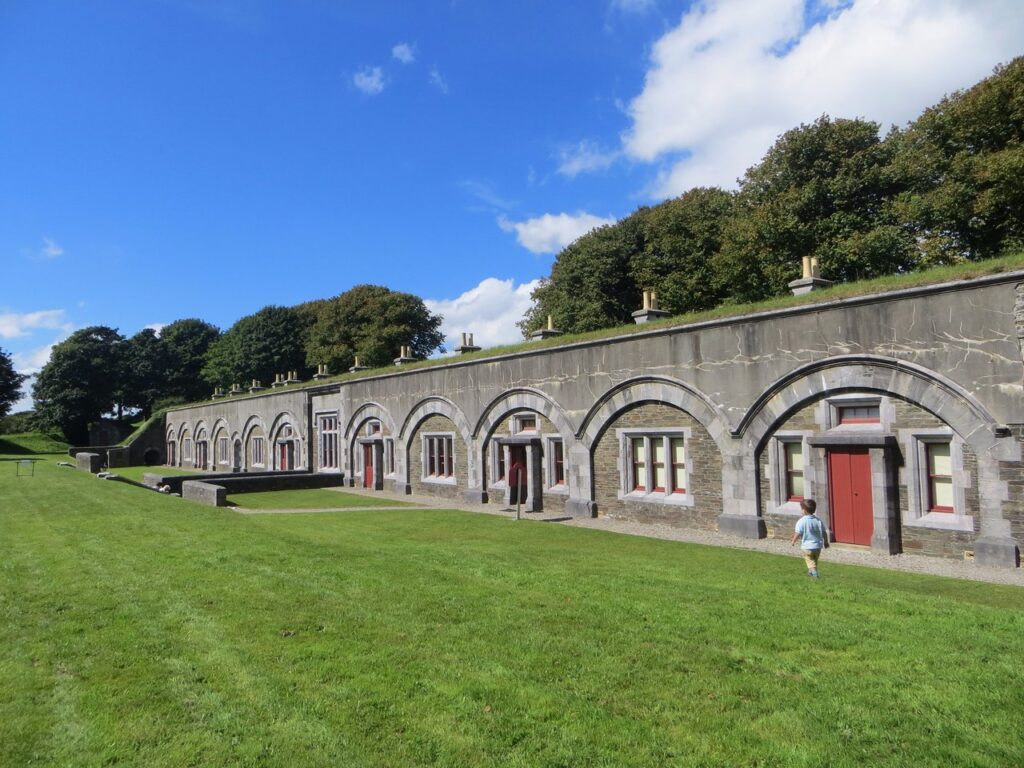
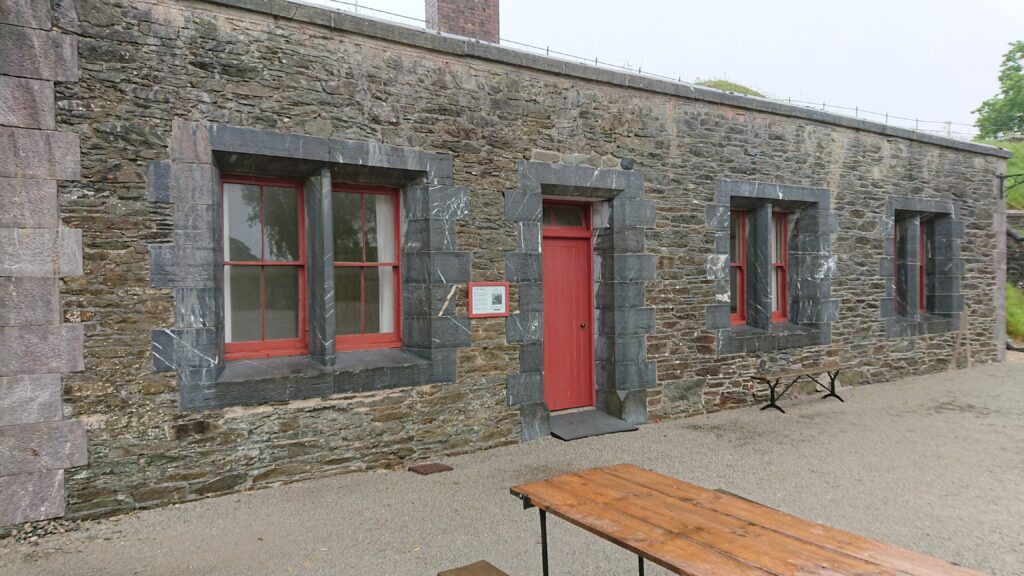
The former officers’ quarters at Crownhill Fort, Plymouth

After five years at our offices in Plymstock, we’ve outgrown the space and are moving to somewhere really special.

Crownhill Fort, built in 1868, is in the north of the city centre and is a tourist destination and conference centre as well as business premises.

The following information is kindly reproduced from the Landmark Trust (owners of the site).

Crownhill Fort was considered the most important of the forts built to defend the Plymouth naval base. Today it is equally important, though for reasons of history rather than defence. Unlike the Victorian defences of Portsmouth, which are well cared for and accessible to the public, many of the Plymouth forts have been damaged by conversion to a variety of private uses. Only Crownhill Fort has survived in anything like its original form.

In 1987 the Landmark Trust, an architectural restoration charity, recognised the importance of Crownhill Fort and, wishing to give it a secure future, purchased it from the Ministry of Defence. The Trust’s intention was not only to ensure the Fort’s preservation and to restore its original layout as far as possible, but also to open it to visitors so that they might learn and profit from the experience.

Crownhill Fort, the largest, most advanced, and least altered of Plymouth’s 19th century forts, commands one of the highest points in the city yet is surprisingly inconspicuous. Though covering 16 acres and surrounded by a broad, deep ditch hewn from bedrock, the fort appears from only a short distance to be nothing but a forested hilltop. There are, however, four fighting levels with placements for 32 cannons and six mortars, nearly a half mile of tunnels, and accommodation for 300 soldiers and officers concealed within it.

Crownhill Fort was the key to the North-East Defences of Plymouth which stretched from the Tamar River in the west to the Cattewater in the east and included nine other forts and batteries and one keep in between. It was built as part of the largest fortress building boom in British history against the perceived threat of French invasion. There were mutual feelings of fear and distrust between the two nations and after France launched the armoured steam frigate “La Gloire” in 1858, the British Navy’s ability to defend the country was seen to be gravely threatened.

Steam power had greatly improved the accuracy and range for artillery. The adoption of explosive shells, combined with ironclad ships reduced the effectiveness of existing defences. The Channel had been an obstacle to sailing ships, but by mid-century was ‘nothing more than a river passable by a steam bridge.’ In 1859, the Prime Minister, Lord Palmerston, responded to the alarm from a Royal Commission report on the defences of the United Kingdom.

The commission called for a massive fortress building programme to protect dockyards and strategic harbours at an estimated cost of £111,850,000. Parliament reduced the scales of the undertaking but nonetheless by 1867, 76 forts and batteries had been built or were under construction around the principal naval ports of Britain. Over £3,000,000 was spent on the Plymouth defences alone, with Crownhill Fort construction costing £76,000.

Crownhill Fort, along with the rest of the North-East Defences, was designed by Captain (later Major General) Edmund DuCane who also designed Staddon Fort and, with Captain William Crossman, Tregantle Fort. The great advances in military technology enabled them to break from the centuries old practice of continuous line defences. Each of the forts was designed as a polygon surrounded by a ditch which itself was protected by caponiers (powerful, casemated structures which provided flanking fire across the ditch). Guns, sometimes in casemates, lined the tops of the ramparts and the barrack blocks within were made bomb-proof by the use of mounded earth.

From its completion in 1872 until 1986, Crownhill Fort was under continuous military occupation. Various gun pits remain from World War II and the fort was used as an assembly point by forces leaving for the Falklands War.

The new office in the Old Cook House

Managing Director Glyn Rowett said of the move: “It’s a fascinating historical building but customers can be sure that our working practices are as modern as ever, bringing quotes and renewals to you quickly with our customary personal service. Come and pay us a visit and enjoy a stroll around the grounds while you’re there.”

The new office address is The Old Cook House, Crownhill Fort, Crownhill Fort Rd, Plymouth, PL6 5BX and the numbers to call are: 01752 774686 or 01752 480048.