two people discussing business with a laptop

Underinsurance explained, with Aviva

What is underinsurance?

Underinsurance occurs when you don’t have enough insurance cover to meet your needs. So, if the declared values of property and assets aren’t correct, or when the time it would take to get your business back up and running after a loss is underestimated, you could be underinsured.

Unfortunately, the unexpected can happen and you may need to make a claim. If you do, the last thing you want to hear is that the level of insurance cover you have won’t cover your costs. But that’s what could happen if you’re underinsured.

How could I be underinsured?

Incorrect Sums Insured limit

It’s not nice to think of, but if you were to suffer a large loss tomorrow, how much would it cost to completely rebuild and reinstate your business?

This is what your Sums Insured limit covers. And it’s not just the bricks and mortar. This covers the cost of replacing key components including plant machinery, and equipment.

Inadequate Business Interruption (BI)

If you’ve thought about the cost of rebuilding and reinstating your business, how long do you think it would take to get all of that building work agreed and completed, and your equipment ordered and installed? Not to mention the time it will take to build back your customer base to previous levels. This is where your business interruption period comes into play. If your BI limit isn’t adequate, you may not be able to cover the full estimated loss of earnings during a period of reinstatement, leaving you financially vulnerable.

Not reviewing these limits regularly

If you haven’t had an independent professional valuation done in the last 12 months, we’d highly recommend you do so. It can be difficult to understand exactly how much cover you need at the best of times, but right now, it’s trickier than ever – inflation, increased cost of building materials, supply chain disruption and a shortage of skilled workers are all causing the cost of getting back to business to go up.

What about indexation?

If the initial Sum Insured are too low, the indexation applied to your policy in line with inflation may have little to no impact. What’s more, inflation indexation alone won’t account for costly delays or increases in other costing factors.

Aviva Business Insurance
From Aviva

Did you know…

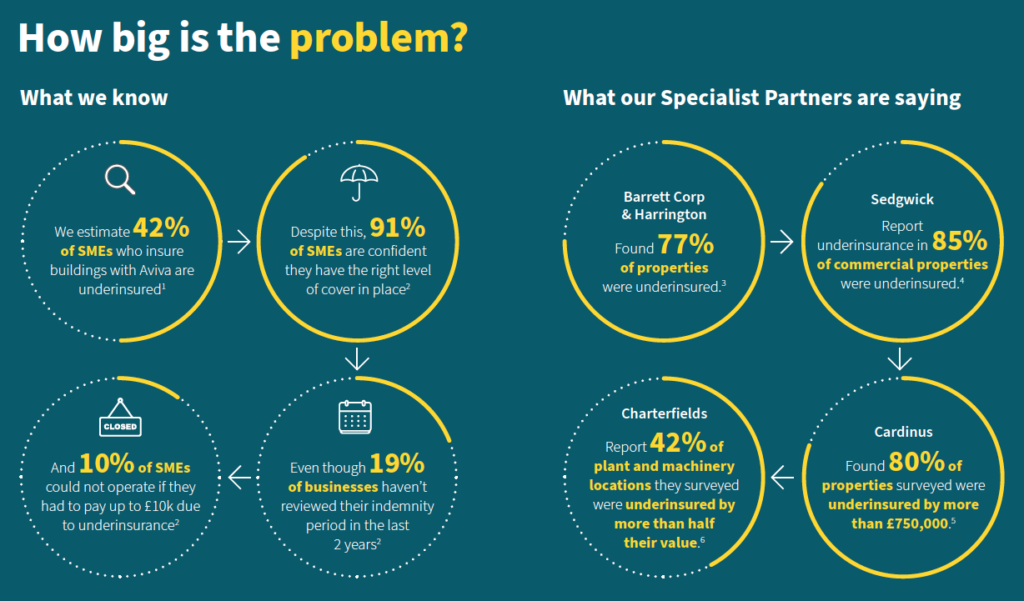
10% of SMEs – that’s more than half a million UK businesses – believe they wouldn’t survive if they had to pay up to £10,000 towards a claim that wasn’t fully covered by insurance.

Why won’t an insurer always cover the full loss?

Any claim will only be paid based on the amount of cover chosen. This is called the ‘average clause’. Any claim you need to make – however big or small – will be impacted by the percentage difference between your recommended total sum and the actual sum for which you’re insured.

You should carefully consider the percentage difference between the recommended cover limits and the amount you choose to cover, rather than simply focusing on the total amounts.

What are the consequences?

  • Production delays
  • Employee wellbeing issues
  • Cash flow problems
  • Loss of revenue
  • Supply chain problems
  • Impact on share price
  • Loss of key employees
  • Disappointed customers
  • Reputational damage

How long will it take to get back to normal?

We call this the ‘period of indemnity’. Making sure you have calculated this correctly protects your income and cash flow if anything impacts normal operations. It can often take longer than you think to bounce back.

For instance, if a business needed to rebuild a warehouse after a fire, attaining planning permission could delay work for months. If just one piece of specialist equipment breaks down, it could mean they can’t run properly until a replacement can be sourced.

A recent analysis of large claims (over £100,000) settled by Aviva between 2018 and 2021 found that the average lifecycle to close a claim was 385 days.

However, on average, SMEs said it would take just under six months for their business to be able to return to normal operations following a major loss, such as a fire or flood. If you’re not sure what your period of indemnity should be, speak to your broker.

How do you know if you’re underinsured?

  1. Get a professional valuation
    Working out how much accidents, and other business interruptions, could set you back can be complex. But having to pay more than you bargained for – or waiting longer than you thought to get back up and running – could leave your business struggling. An expert valuation can help you get a true idea of the total value of your assets, so you can choose an appropriate level of cover.
  2. Have regular catch-ups with your broker
    It can also be difficult to stay on top of the market conditions that could affect your insurance policy – such as labour shortages, rising material costs, or wider supply chain issues. Regular catch ups with your broker can help you understand how much cover you need. It’s also important to tell them about changes you’ve made. Things like new plant and machinery, property alterations and inflated stock levels can impact the level of cover required.

Get in touch with us to discuss your policy and check you have the right level of cover in place: 01726 871144 / 69400.

Further reading and case studies

Click to read
planning ahead for business insurance

What do business owners need to know about renewing insurance in 2023?

As a business owner, ensuring adequate insurance coverage is crucial for protecting your company’s assets and mitigating potential risks. With each passing year, the insurance landscape evolves, and it becomes essential to review and renew your insurance policies to align with the changing business environment. In this blog, we will discuss the key considerations business owners should keep in mind when renewing their insurance in 2023, enabling them to make informed decisions and safeguard their operations.

Evaluate Changes in Business Operations:

Before renewing your insurance, carefully assess any significant changes in your business operations. Have you introduced new products or services? Expanded your premises or workforce? Entered new markets or adopted innovative technologies? Understanding these changes will help you determine if your existing insurance coverage adequately protects against the specific risks associated with your evolving business activities.

Conduct a Comprehensive Risk Assessment:

Conducting a thorough risk assessment is crucial in determining the appropriate insurance coverage for your business. Identify and evaluate potential risks, such as property damage, liability claims, cybersecurity threats, supply chain disruptions, and natural disasters. By understanding your risk exposure, you can ensure that your insurance policies provide sufficient coverage and offer protection tailored to your unique business needs.

Review Existing Insurance Policies

Take the time to review your current insurance policies in detail. Understand the scope of coverage, exclusions, deductibles, and policy limits. Assess whether your existing policies adequately cover your business’s risks and if any adjustments are necessary. Consider consulting with an insurance professional who can provide expert guidance and help you navigate complex policy terms and conditions.

Seek Competitive Quotes

Don’t settle for the status quo when renewing your insurance. The insurance market is dynamic, and new offerings may better suit your business requirements or provide more competitive premiums. Engaging a good insurance broker can streamline this process, as we have access to a wide range of insurers and can negotiate on your behalf to secure the best possible coverage at favourable rates.

Understand Emerging Risks and Coverage Gaps

Stay informed about emerging risks and potential coverage gaps that may impact your business in 2023. Technological advancements, data privacy regulations, environmental concerns, and evolving legal landscapes can introduce new risks that require specialised insurance coverage. Keep abreast of industry trends and consult with your insurance provider or broker to ensure that your policies address these emerging risks adequately.

Consider Bundling Insurance Policies

Bundling your insurance policies with a single provider can offer several advantages. It simplifies the administrative process, provides potential cost savings through package discounts, and ensures seamless coverage across different areas of your business. Discuss with your insurance provider if bundling options are available and evaluate the benefits and potential drawbacks based on your specific business needs.

Review Business Interruption Coverage

The COVID-19 pandemic highlighted the importance of business interruption insurance. Assess whether your existing policy adequately covers potential income loss due to unforeseen events such as natural disasters, supply chain disruptions, or civil unrest. Understand the policy terms, waiting periods, and coverage limits associated with business interruption insurance to ensure you are adequately protected against such risks.

Regularly Update Your Insurance

Insurance needs should not be a one-time consideration. As your business evolves, regularly review and update your insurance coverage to reflect new risks and changes in operations. Set a reminder to reassess your insurance needs annually or whenever significant changes occur within your business. Staying proactive and responsive to evolving circumstances will help you maintain comprehensive and up-to-date insurance protection.

How Rowett Insurance can help

Renewing insurance for your business in 2023 requires careful evaluation, proactive risk assessment, and thorough policy review. Get in touch with Rowett Insurance Broking Limited on 01726 871144 to help you get this right.

flooding in a town - flood insurance

Business continuity advice: preparing for summer storms

While weather forecasting has improved significantly throughout the years, there is still little warning of when and where localised flash flooding may take place.

Recent heatwaves (and more extreme conditions) have intensified flooding throughout Europe and the UK. While climate change may be largely to blame, overtaxed drainage systems and inadequate risk management strategies have led to catastrophic damage for both residential and commercial properties.

Risk management is an essential part of any effective business. What steps can you take to enhance your preparedness and account for possible insurance risks?

Flash flooding in Europe

Even climate scientists are shocked by the scale of recent summer floods in Germany. In an area that usually sees 80 litres of rainfall in the entire month of July, 148 litres per square metre fell in just 48 hours in parts of Rhineland-Palatinate and North Rhine- Westphalia. Switzerland documented their heaviest rainfall on record, after a Zurich thunderstorm saw 4cm falling overnight. This led to flash flooding, logistical issues and travel chaos in the city and its surrounds.

UK flash floods

Closer to home, west London was hit by severe flooding in early July 2021. Water rushed towards the platforms at Sloane Square station, barriers were erected in Chalk Farm and Hampstead, Euston station was closed, and in Primrose Hill people were seen swimming in ponds created by thunderstorms.

While climate change is largely to blame, overtaxed drainage systems exacerbate the problem. Thus was the case for the Gough family who saw their new home submerged after unexpected flash flooding in Dorset. They believe that the damage was caused by inadequate drainage maintenance.

These systems not only reduce peak water levels, but give communities affected by flooding, more time to prepare for the worst. While the consequences for residential properties can be personally tragic, the outcomes for commercial properties can be catastrophic, for both you and your employees.

In addition to physical flood damage to the premises itself, losses can also incur from business interruption and damage to stock, equipment, fixtures and fittings and general contamination. The effects on business continuity cannot be understated, a flood can be devastating.

Flood preparation

According to Insurance company QBE, “planning in advance and taking a few sensible precautions could save disruption and money, should the worst occur”. As part of your overall business continuity plan, some of the measures that they suggest include:

·         Not storing stock directly on the floor. Even raising it by 100mm can make a big difference

·         If you can, avoid storing stock/objects directly under valley gutters. If not, then try and store lower value, less vulnerable goods in these areas

·         Check that normal surface water drains and other flow routes are unobstructed

·         Electrical, electronic, and other sensitive equipment may be directly under potential water entry points. In the short term, think how you can protect it; in the longer term, ask yourself if this is the correct location for it.

Consider cellars, basements, trenches, pits, loading docks and other low-lying areas. After an extended dry period, water run off paths may be significantly different from the usual routes. If you have had any incidence of water ingress before, then be prepared with sandbags, flood barriers or similar solutions.

Protect yourself with flood insurance

While many flooding incidents cannot be prevented, proper preparation, risk management strategies and adequate insurance can help to mitigate the physical and financial fallout, including loss of income. All business owners need to take account of these risks as part of the effective operation of your business.

At Rowett Insurance, we can help you to find the right level of cover for you, call our team on 01726 871144.

a business woman with a mobile phone in an office

Learn more about business insurance add-ons

When it comes to protecting your business, having insurance is essential. However, many business owners are not aware of the full range of add-ons available to them when it comes to business insurance in the UK. In this blog, we will explore some of the lesser-known add-ons for business insurance in the UK.

Cyber Insurance

In today’s digital age, cyber-attacks have become increasingly common. Cyber insurance provides coverage for losses resulting from cyber-attacks, such as data breaches, cyber extortion, and business interruption due to cyber incidents. This type of insurance can also provide assistance with managing the fallout of a cyber-attack, including the cost of public relations and legal advice.

Directors and Officers Liability Insurance

Directors and officers liability insurance protects the personal assets of company directors and officers in the event of legal action being taken against them. This type of insurance provides coverage for legal expenses, settlements, and judgments resulting from alleged wrongful acts, such as breach of fiduciary duty, negligence, and financial mismanagement.

Professional Indemnity Insurance

Professional indemnity insurance is a type of insurance that protects businesses that provide professional services, such as architects, accountants, and consultants, against claims of negligence, errors, or omissions made in the course of their work. Professional indemnity insurance covers the cost of legal defence and any damages awarded to the claimant.

Business Interruption Insurance

Business interruption insurance provides coverage for losses resulting from events that cause a business to close temporarily, such as a fire, flood, or other natural disaster. Business Interruption insurance covers the costs of lost revenue, ongoing expenses, and the cost of getting the business back up and running.

Terrorism Insurance

Terrorism insurance provides coverage for losses resulting from acts of terrorism. This type of insurance is particularly relevant for businesses that operate in high-risk areas or industries, such as transportation or finance.

Having the right insurance in place can protect your business from a wide range of risks. It’s important to work with a reputable insurance broker to ensure you have the right level of coverage for your business’s needs. By exploring the lesser-known add-ons for business insurance in the UK, you can ensure that you have comprehensive coverage to protect your business in the event of unforeseen circumstances. Want to know more about how you can boost your business insurance? Get in touch with us on 01726 871144.

busy people walking inside an office

What Does Business Resilience Mean To You?

Did you know that nearly 1 in 5 UK businesses suffer a major disruption once a year? Change is inevitable and it’s impossible to predict what’s around the corner. Over the past few years, UK businesses alone have faced Brexit, the Covid-19 pandemic and most recently, the cost-of-living crisis. How prepared was your business for these events? Is there anything that you would change if you had to face something similar again?

Managing change isn’t easy, but with processes and workflows in place that set out what your business should do in the face of a major disruptive event, organisations have a better chance of continuing to operate through turbulent times. We look at what your business needs to do to become more resilient to disruptive events, helping you to make the right choices among the chaos. 

What is business resilience?

The term ‘business resilience’ describes a business’s ability to adapt to, and continue to operate under, unforeseen disruption. This can include natural disasters, economic disrepair and major supply chain failures. To become resilient, a business should have a series of holistic management processes – or a ‘business resilience plan’ in place for the ‘what ifs’ – changes that have the potential to cause significant disruption to the day-to-day running of your business.

For example:

  • What if your business is affected by a flood or fire?
  • What if your energy supply was interrupted for a day? What if it was a week?
  • What if your business was targeted by a cyberattack, resulting in a data breach?
  • While it’s impossible to predict exactly what the future holds, by having a series of processes in place, your business will be better prepared should disaster strike.

Creating a business resilience plan

There are several stages to building a business resilience plan, including:

Analysis – Conducting a full risk evaluation to determine your priorities, how these would be impacted by key disruptions and how much time you would have before the situation became critical. At this stage, you should consider your resources and what is realistic for your organisation.

Design and Implementation – Consider the processes and strategies required for your business to correctly respond to and recover from the key disruptions above. These processes will need to account for areas such as business processes, who is responsible for what, backup arrangements and emergency contacts. Consider how will these be presented – will they be heavily detailed or set out as a series of checklists?

Testing – It’s crucial that you immediately test your plans for any gaps or discrepancies, you can do this using walkthrough exercises or by using online or physical simulations. You can then tweak the processes based on your findings.

Business resilience and insurance

While creating a business resilience plan can make the difference between a company surviving unexpected events or not, for many, being truly resilient as a business means much more than simply having a Business Continuity Plan in place.

Part of ensuring your business is resilient is making sure that you have the right insurance in place. From Business Interruption cover to Cyber Insurance, these policies are all geared to ensuring that you have financial support should disaster strike. Without the right foundations, your business could be in trouble from the offset.   

To make sure you get this right, at Rowett Insurance Broking Limited, we know insurance inside and out and can help you shape a policy that mitigates the risks that your business faces. To find out more about how we can help your business, just get in touch on 01726 871144 option 3 or visit our dedicated commercial insurance pages.