What is underinsurance?
Underinsurance occurs when you don’t have enough insurance cover to meet your needs. So, if the declared values of property and assets aren’t correct, or when the time it would take to get your business back up and running after a loss is underestimated, you could be underinsured.
Unfortunately, the unexpected can happen and you may need to make a claim. If you do, the last thing you want to hear is that the level of insurance cover you have won’t cover your costs. But that’s what could happen if you’re underinsured.
How could I be underinsured?
Incorrect Sums Insured limit
It’s not nice to think of, but if you were to suffer a large loss tomorrow, how much would it cost to completely rebuild and reinstate your business?
This is what your Sums Insured limit covers. And it’s not just the bricks and mortar. This covers the cost of replacing key components including plant machinery, and equipment.
Inadequate Business Interruption (BI)
If you’ve thought about the cost of rebuilding and reinstating your business, how long do you think it would take to get all of that building work agreed and completed, and your equipment ordered and installed? Not to mention the time it will take to build back your customer base to previous levels. This is where your business interruption period comes into play. If your BI limit isn’t adequate, you may not be able to cover the full estimated loss of earnings during a period of reinstatement, leaving you financially vulnerable.
Not reviewing these limits regularly
If you haven’t had an independent professional valuation done in the last 12 months, we’d highly recommend you do so. It can be difficult to understand exactly how much cover you need at the best of times, but right now, it’s trickier than ever – inflation, increased cost of building materials, supply chain disruption and a shortage of skilled workers are all causing the cost of getting back to business to go up.
What about indexation?
If the initial Sum Insured are too low, the indexation applied to your policy in line with inflation may have little to no impact. What’s more, inflation indexation alone won’t account for costly delays or increases in other costing factors.
Aviva Business Insurance
Did you know…
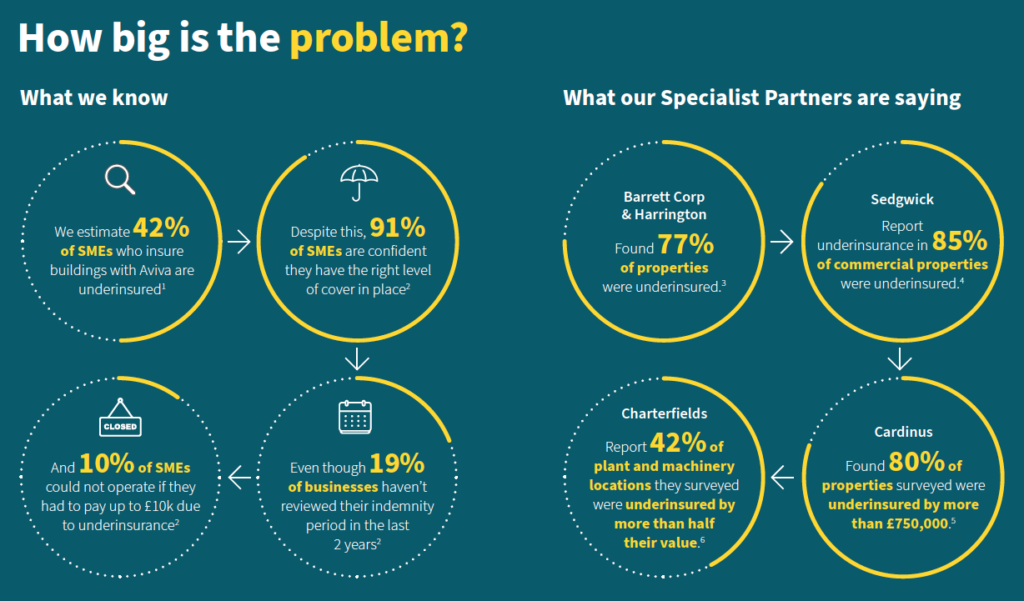
10% of SMEs – that’s more than half a million UK businesses – believe they wouldn’t survive if they had to pay up to £10,000 towards a claim that wasn’t fully covered by insurance.
Why won’t an insurer always cover the full loss?
Any claim will only be paid based on the amount of cover chosen. This is called the ‘average clause’. Any claim you need to make – however big or small – will be impacted by the percentage difference between your recommended total sum and the actual sum for which you’re insured.
You should carefully consider the percentage difference between the recommended cover limits and the amount you choose to cover, rather than simply focusing on the total amounts.
What are the consequences?
- Production delays
- Employee wellbeing issues
- Cash flow problems
- Loss of revenue
- Supply chain problems
- Impact on share price
- Loss of key employees
- Disappointed customers
- Reputational damage
How long will it take to get back to normal?
We call this the ‘period of indemnity’. Making sure you have calculated this correctly protects your income and cash flow if anything impacts normal operations. It can often take longer than you think to bounce back.
For instance, if a business needed to rebuild a warehouse after a fire, attaining planning permission could delay work for months. If just one piece of specialist equipment breaks down, it could mean they can’t run properly until a replacement can be sourced.
A recent analysis of large claims (over £100,000) settled by Aviva between 2018 and 2021 found that the average lifecycle to close a claim was 385 days.
However, on average, SMEs said it would take just under six months for their business to be able to return to normal operations following a major loss, such as a fire or flood. If you’re not sure what your period of indemnity should be, speak to your broker.
How do you know if you’re underinsured?
- Get a professional valuation
Working out how much accidents, and other business interruptions, could set you back can be complex. But having to pay more than you bargained for – or waiting longer than you thought to get back up and running – could leave your business struggling. An expert valuation can help you get a true idea of the total value of your assets, so you can choose an appropriate level of cover. - Have regular catch-ups with your broker
It can also be difficult to stay on top of the market conditions that could affect your insurance policy – such as labour shortages, rising material costs, or wider supply chain issues. Regular catch ups with your broker can help you understand how much cover you need. It’s also important to tell them about changes you’ve made. Things like new plant and machinery, property alterations and inflated stock levels can impact the level of cover required.
Get in touch with us to discuss your policy and check you have the right level of cover in place: 01726 871144 / 69400.
Further reading and case studies
Click to read