two people discussing business with a laptop

Underinsurance explained, with Aviva

What is underinsurance?

Underinsurance occurs when you don’t have enough insurance cover to meet your needs. So, if the declared values of property and assets aren’t correct, or when the time it would take to get your business back up and running after a loss is underestimated, you could be underinsured.

Unfortunately, the unexpected can happen and you may need to make a claim. If you do, the last thing you want to hear is that the level of insurance cover you have won’t cover your costs. But that’s what could happen if you’re underinsured.

How could I be underinsured?

Incorrect Sums Insured limit

It’s not nice to think of, but if you were to suffer a large loss tomorrow, how much would it cost to completely rebuild and reinstate your business?

This is what your Sums Insured limit covers. And it’s not just the bricks and mortar. This covers the cost of replacing key components including plant machinery, and equipment.

Inadequate Business Interruption (BI)

If you’ve thought about the cost of rebuilding and reinstating your business, how long do you think it would take to get all of that building work agreed and completed, and your equipment ordered and installed? Not to mention the time it will take to build back your customer base to previous levels. This is where your business interruption period comes into play. If your BI limit isn’t adequate, you may not be able to cover the full estimated loss of earnings during a period of reinstatement, leaving you financially vulnerable.

Not reviewing these limits regularly

If you haven’t had an independent professional valuation done in the last 12 months, we’d highly recommend you do so. It can be difficult to understand exactly how much cover you need at the best of times, but right now, it’s trickier than ever – inflation, increased cost of building materials, supply chain disruption and a shortage of skilled workers are all causing the cost of getting back to business to go up.

What about indexation?

If the initial Sum Insured are too low, the indexation applied to your policy in line with inflation may have little to no impact. What’s more, inflation indexation alone won’t account for costly delays or increases in other costing factors.

Aviva Business Insurance
From Aviva

Did you know…

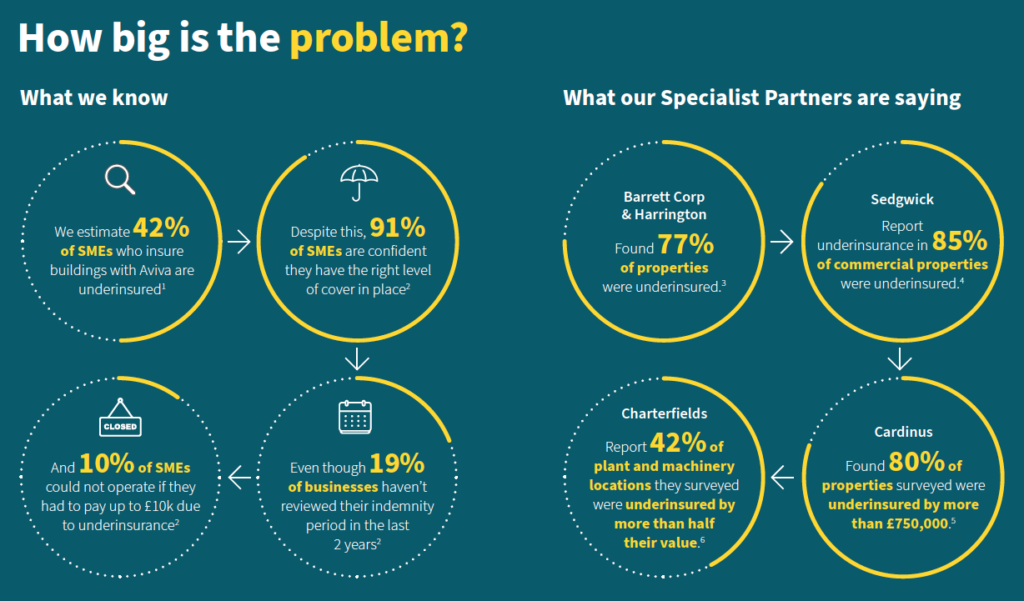
10% of SMEs – that’s more than half a million UK businesses – believe they wouldn’t survive if they had to pay up to £10,000 towards a claim that wasn’t fully covered by insurance.

Why won’t an insurer always cover the full loss?

Any claim will only be paid based on the amount of cover chosen. This is called the ‘average clause’. Any claim you need to make – however big or small – will be impacted by the percentage difference between your recommended total sum and the actual sum for which you’re insured.

You should carefully consider the percentage difference between the recommended cover limits and the amount you choose to cover, rather than simply focusing on the total amounts.

What are the consequences?

  • Production delays
  • Employee wellbeing issues
  • Cash flow problems
  • Loss of revenue
  • Supply chain problems
  • Impact on share price
  • Loss of key employees
  • Disappointed customers
  • Reputational damage

How long will it take to get back to normal?

We call this the ‘period of indemnity’. Making sure you have calculated this correctly protects your income and cash flow if anything impacts normal operations. It can often take longer than you think to bounce back.

For instance, if a business needed to rebuild a warehouse after a fire, attaining planning permission could delay work for months. If just one piece of specialist equipment breaks down, it could mean they can’t run properly until a replacement can be sourced.

A recent analysis of large claims (over £100,000) settled by Aviva between 2018 and 2021 found that the average lifecycle to close a claim was 385 days.

However, on average, SMEs said it would take just under six months for their business to be able to return to normal operations following a major loss, such as a fire or flood. If you’re not sure what your period of indemnity should be, speak to your broker.

How do you know if you’re underinsured?

  1. Get a professional valuation
    Working out how much accidents, and other business interruptions, could set you back can be complex. But having to pay more than you bargained for – or waiting longer than you thought to get back up and running – could leave your business struggling. An expert valuation can help you get a true idea of the total value of your assets, so you can choose an appropriate level of cover.
  2. Have regular catch-ups with your broker
    It can also be difficult to stay on top of the market conditions that could affect your insurance policy – such as labour shortages, rising material costs, or wider supply chain issues. Regular catch ups with your broker can help you understand how much cover you need. It’s also important to tell them about changes you’ve made. Things like new plant and machinery, property alterations and inflated stock levels can impact the level of cover required.

Get in touch with us to discuss your policy and check you have the right level of cover in place: 01726 871144 / 69400.

Further reading and case studies

Click to read

a padlock on a computer keyboard

The importance of cyber insurance for small businesses

In today’s digital age, small businesses face numerous risks related to cyber threats. With the world becoming increasingly dependent on technology, cybersecurity has become a necessity for small business owners. Cyber insurance is an essential tool that can help mitigate these risks and protect businesses from potential financial losses.

43 percent of all cyberattacks target SMEs

Small businesses are increasingly becoming targets of cyber attacks. A study by Verizon shows that 43 percent of all cyberattacks target small businesses. These attacks can have significant financial implications for small businesses, and in some cases, lead to bankruptcy. Cyber insurance provides financial protection to businesses against these types of attacks.

Protecting your data

One of the most significant risks that small businesses face is data breaches. A data breach can occur when a business’s sensitive information is accessed by unauthorized individuals. This can lead to identity theft, financial loss, and damage to the business’s reputation. Cyber insurance can help cover the costs associated with a data breach, including legal fees, notification costs, and the cost of providing credit monitoring for affected individuals.

Increasing risk of ransomware attacks

Ransomware attacks are also becoming increasingly common among small businesses. Ransomware is a type of malware that encrypts a business’s files and demands payment in exchange for the decryption key. Cyber insurance can help businesses recover from a ransomware attack by covering the cost of data recovery and ransom payments.

Disrupting your day-to-day

Small businesses are also at risk of business interruption due to cyber attacks. For example, if a business’s website is taken down by a DDoS attack, they may lose revenue from online sales. Cyber insurance can help cover the costs associated with business interruption, including lost income and extra expenses incurred to get the business back up and running.

Additional layer of protection for businesses 

It’s important to note that cyber insurance is not a substitute for cybersecurity measures. Small businesses should still take steps to protect themselves from cyber threats, such as implementing strong passwords, encrypting sensitive data, and training employees on cybersecurity best practices. However, cyber insurance can provide an additional layer of protection for businesses that may not have the resources to implement robust cybersecurity measures.

In conclusion, cyber insurance is essential for small businesses to protect themselves from the financial losses associated with cyber attacks. With the increasing frequency and severity of cyber threats, cyber insurance has become a necessary investment for small business owners. By investing in cyber insurance, small businesses can safeguard their finances and continue to operate even in the face of cyber attacks. Want to know more? Get in touch with us on 01726 871144 option 3. Or head to our dedicated page on cyber insurance for more information.

holding a sparkler against a dark sky

Some New Year’s Resolutions For Business Owners

Does your list of New Year’s resolutions look something like this?

  1. Do more exercise at least three times a week.
  2. Save more money.
  3. Give up smoking, drinking and chocolate – unless it’s the weekend.
  4. Learn a new language.
  5. Volunteer more.

Wait… what was the first one again?

New Year’s resolutions are great, that is, if we keep them. Unfortunately, statistics reveal that 80% of all New Year’s resolutions have already been broken by February. This is mostly because we set ourselves the highest of standards which cannot usually be reached without the strongest of willpower and more time than we have available to us.

Whilst the odds may be against you, it’s still worth setting yourself achievable goals to measure your performance by and what better time to start at the start of a shiny new year?

We take a look at some business New Year’s resolutions that are achievable, measurable and realistic.

Review your mission

It’s good to re-evaluate your business plan, your company mission and your USPs at the start of each year in order to ensure that you, your employees and your customers are up to date, on the same page and working towards the same goals.

Create measurable goals

Think about setting SMART goals, that is – Specific, Measurable, Actionable, Realistic and Timed.  Think clearly about what you want to achieve and the timescales in which you want to achieve it. Ensure that your goals are realistic and think of a way you can measure the progress and success of a goal. Try not to leave the timescale open-ended, working to a deadline can keep your team on track.

Reflect on your business expenditure

Take time to look over your business expenditure and try to identify areas in which you can cut costs. Maybe you’re leasing equipment when it would now be cheaper and more efficient for you to buy it outright, or vice versa? Now’s the time to make some changes to free up your budget.

Delegation

Review the roles of your employees to see if certain tasks can be delegated across roles to free up more time for work which only certain members of staff can complete. It can be tempting to take on everything yourself to ensure it’s done right but allowing other to take care of time-consuming tasks can leave you with more time to concentrate on growing your business.

Take advantage of social media

Many of us put social media on the backbench when things get busy, however, this can be detrimental to your customer engagement, marketing strategy and digital presence. If your business currently doesn’t have the funds or capacity to accommodate a full-time social media guru, you can take advantage of a content planner which allows you to create and schedule posts months in advance, so you’re covered during the busier periods.

Draft up a timeline

Make a simple list of what you want to accomplish during the year and note them down on a timeline for the year, broken down by the month. Doing this alongside more concise goals can be a great way to get both an in-depth perspective and a broader overview of whether you’re staying on track throughout the year.

Check that your insurance is up to date

Finally, you need to ensure that your insurance is still suitable for your business, taking into account any changes throughout the past year. For help with this, call Rowett Insurance Broking Limited on 01726 871144 option 3. We will evaluate your existing cover and recommend any changes or a policy which may be more suitable to your future operation.

a padlock on a computer keyboard

Multi-Factor Authentication – What is it and what it means for your business  

Have you heard of Multi-Factor Authentication or MFA? 

While it might not mean much to some of you, it’s about to become one of the buzzwords in the Cyber Insurance industry. Here’s why.

What is Multi-Factor Authentication?

Multi-Factor Authentication requires system users to go through two layers of identification to access control of a system. Think about the systems you access regularly. Your ATM for example, the first layer of identification is your debit card, the second is your PIN. Or when you enter your credit card details online, each piece of information you provide is a separate layer of authentication, including your card number, expiry date and security code. Many providers also ask you to verify the purchase using an app – another layer of authentication.

Something you know, something you have, something you are

Multi-Factor Authentication is sometimes referred to as:

Something you know: A username or password

Something you have: Verification text on a mobile, key fob

Something you are: Biometric authentication, including fingerprint or retina scans

Multi-factor authentication is successfully enabled when at least two of these categories are required to successfully verify someone’s identity before gaining access to a system.

Why is it important?

Multi-Factor Authentication is important as it helps to make sure that a business’s IT systems remain secure, along with their customer and staff data. It effectively makes accessing it more difficult for cybercriminals to target your business. The harder your systems are to access, the less of a target you will be. It also helps to target natural human error – are your employees using the same passwords for everything? The more stringent password policies you set, the more time your IT team will spend resetting them – Multi-Factor Authentication helps to remove this pressure.

What it means for your Cyber Insurance

Multi-Factor Authentication isn’t currently a requirement for all insurers who provide Cyber Insurance policies, but it is heading in that direction. Cyber Insurance claims are being made thick and fast and many of these start with compromised passwords or IDs. It’s your responsibility as a business to ensure that you have sufficient levels of cyber security in place to prevent such an attack from happening and Multi-Factor Authentication is simple and low cost way to improve your cyber security.

If you are interested in a quote for cyber insurance please visit our website or phone 01726 871144 option 3 for the commercial department.